

Euro area economic and financial developments by institutional sector: fourth quarter of 2025
28 April 2026
- Euro area net saving increased to €873 billion in 2025, compared with €867 billion in four quarter period ending on third quarter of 2025
- Household debt-to-income ratio decreased to 81.4% in 2025 from 81.7% one year earlier
- Non-financial corporations’ debt-to-GDP ratio (consolidated measure) decreased to 65.8% in 2025 from 67.3% one year earlier
Total euro area economy
Euro area net saving increased to €873 billion (6.9% of euro area net disposable income) in 2025 compared with €867 billion in the four quarter period ending on the third quarter of 2025. Euro area net non-financial investment increased to €602 billion (4.8% of euro area net disposable income), due to increased investment by general government and households while net investments by financial corporations and non-financial corporations remained broadly stable (see Chart 1).
Euro area net lending to the rest of the world decreased to €301 billion (from €310 billion previously), as the increase in net non-financial investment more than offset the net saving increase. Households net lending decreased to €585 billion (4.6% of net disposable income) from €602 billion. Net lending of non-financial corporations (€62 billion, i.e. 0.5% of net disposable income) and that of financial corporations (€116 billion, i.e. 0.9% of net disposable income) were both broadly unchanged. General government net borrowing decreased (-€462 billion, i.e. ‑3.7% of net disposable income, after -€468 billion), contributing less negatively to euro area net lending.
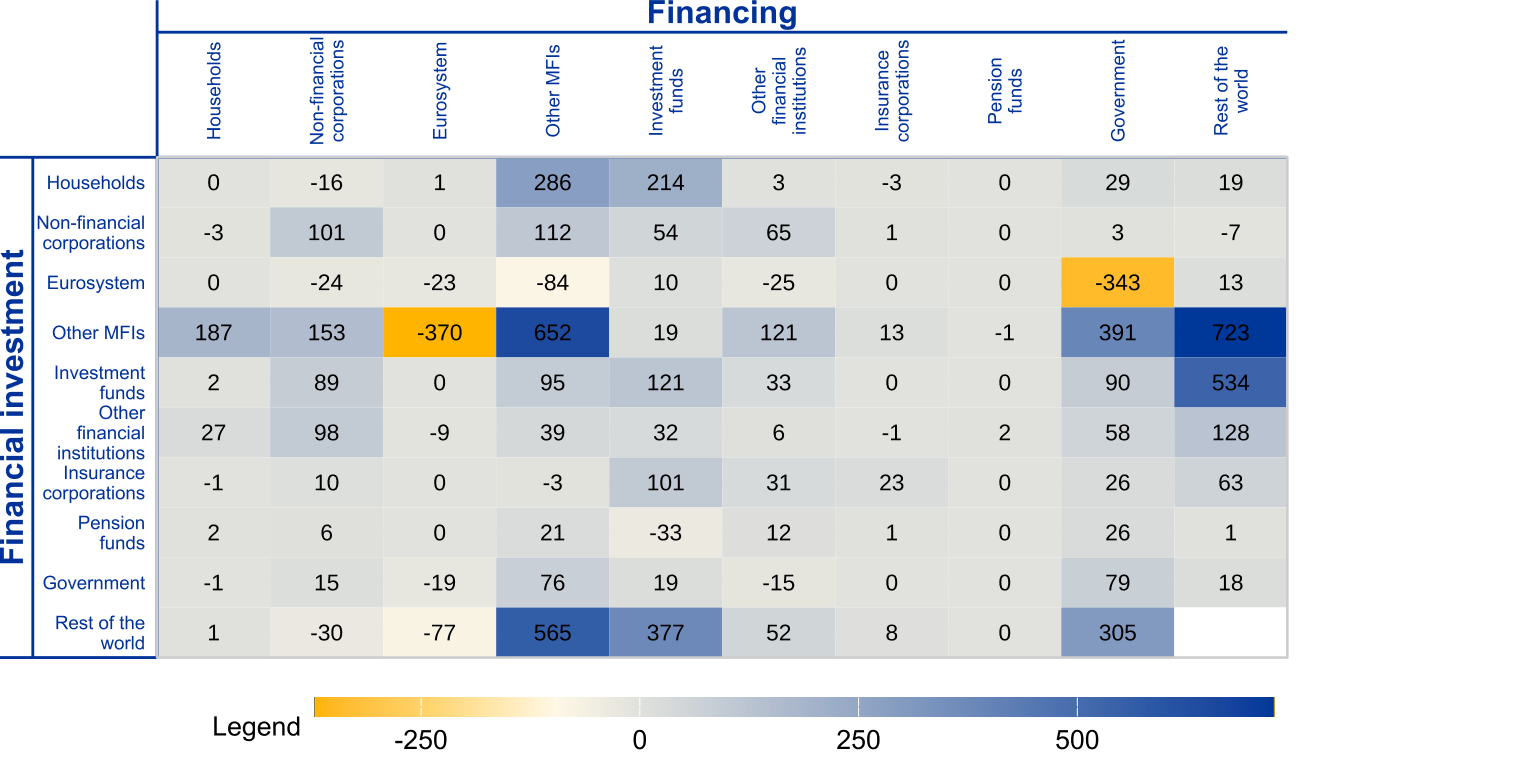
Financial transactions can be presented with a counterpart sector breakdown for deposits, loans, debt securities, listed shares and investment fund shares (see Table 1). In 2025 the largest aggregated transactions among these financial instruments were investments by other MFIs[1] with the rest of the world (€723 billion) and interbank operations – mainly deposits - between other MFIs (€652 billion). Main financial investment activities of households involved transactions vis-à-vis other MFIs (€286 billion), mostly in the form of deposits, as well as net purchases of investment fund shares (€214 billion). Non-financial corporations’ largest financing component was from other MFIs (€153 billion), mostly in the form of loans, while financing from within the NFC sector amounted to €101 billion. General government financing from the Eurosystem, mostly in the form of debt securities, decreased (-€343 billion), while those from other MFIs (€391 billion) and from the rest of the world (€305 billion) both increased.
Table 1
Selected financial transactions* between sectors and with the rest of the world
(EUR billions, four-quarter sums, 2025)
Source: ECB.
* Financial instruments for which the counterpart sector breakdown is available: deposits, loans, debt securities, listed shares and investment fund shares/units.
Households
Household financial investment increased at a broadly unchanged rate of 2.6% in the fourth quarter of 2025. Among its components, investments in debt securities (3.1%, after 0.0%) and in life insurance (2.7%, after 2.3%) grew at higher rates, while investments in currency and deposits (3.0%, after 3.2%) and in shares and other equity (2.0%, after 2.6%) both increased at lower rates.
Households purchased, in net terms, debt securities, mainly those issued by general government, while selling debt securities issued by MFIs. Households were overall net sellers of listed shares, selling listed shares issued by non-financial corporations and MFIs, while buying listed shares of the rest of the world. Households continued to purchase euro area investment fund shares, both issued by MFIs (money market funds) and by non-money market investment funds (see Table 2 below and Table 2.2. in the Annex).
Table 2
Financial investment and financing of households, main items
(annual growth rates)
Financial transactions |
|||||
|---|---|---|---|---|---|
2024 Q4 |
2025 Q1 |
2025 Q2 |
2025 Q3 |
2025 Q4 |
|
Financial investment* |
2.3 |
2.4 |
2.7 |
2.6 |
2.6 |
Currency and deposits |
2.9 |
3.0 |
3.0 |
3.2 |
3.0 |
Debt securities |
8.4 |
3.1 |
-0.9 |
0.0 |
3.1 |
Shares and other equity** |
2.1 |
2.7 |
3.0 |
2.6 |
2.0 |
Life insurance |
0.7 |
1.2 |
2.1 |
2.3 |
2.7 |
Pension schemes |
2.2 |
2.2 |
2.5 |
2.5 |
2.5 |
Financing*** |
1.3 |
1.6 |
2.5 |
2.7 |
2.6 |
Loans |
1.3 |
1.8 |
2.2 |
2.5 |
2.8 |
Source: ECB.
* Items not shown include: loans granted, prepayments of insurance premiums and reserves for outstanding claims and other accounts receivable.
** Includes investment fund shares.
*** Items not shown include: financial derivatives’ net liabilities, pension schemes and other accounts payable.
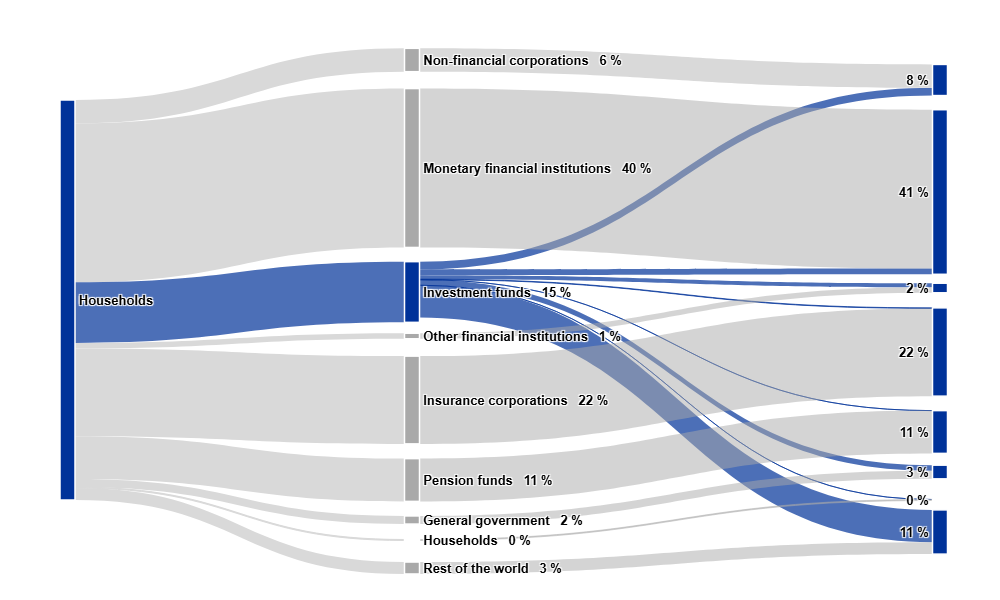
Chart 2 below shows the stock of selected financial assets held by households (in dark blue) vis-à-vis counterpart sectors, at the end of 2025, with investments in investment funds (15% of households’ financial assets) broken down by counterpart sector of the underlying asset.[2] Households’ financial assets were mostly issued by financial intermediaries such as MFIs (41% of households’ financial assets), insurance corporations (22%), pension funds (11%) and the rest of the world (11%). Holdings of financial assets vis-à-vis non-financial corporations (8%), government (3%) and other financial institutions (2%), mainly in the form of listed shares and debt securities, represented lower proportions of households’ financial assets.
Chart 2
Households’ financial assets by counterpart sector; selected financial instruments*
(2025 end of period stocks)
Source: ECB.
Notes: Discrepancies between totals and their components may arise from rounding.
* Financial instruments for which the counterpart sector breakdown is available: deposits, loans, debt securities, listed shares and investment fund shares/units. In addition the counterpart sector breakdown for insurance, pension and standardised guarantee schemes (F.6) is an estimate. (See the methodological note on the ECB’s website: Extension of the who-to-whom presentation to insurance and pension assets).
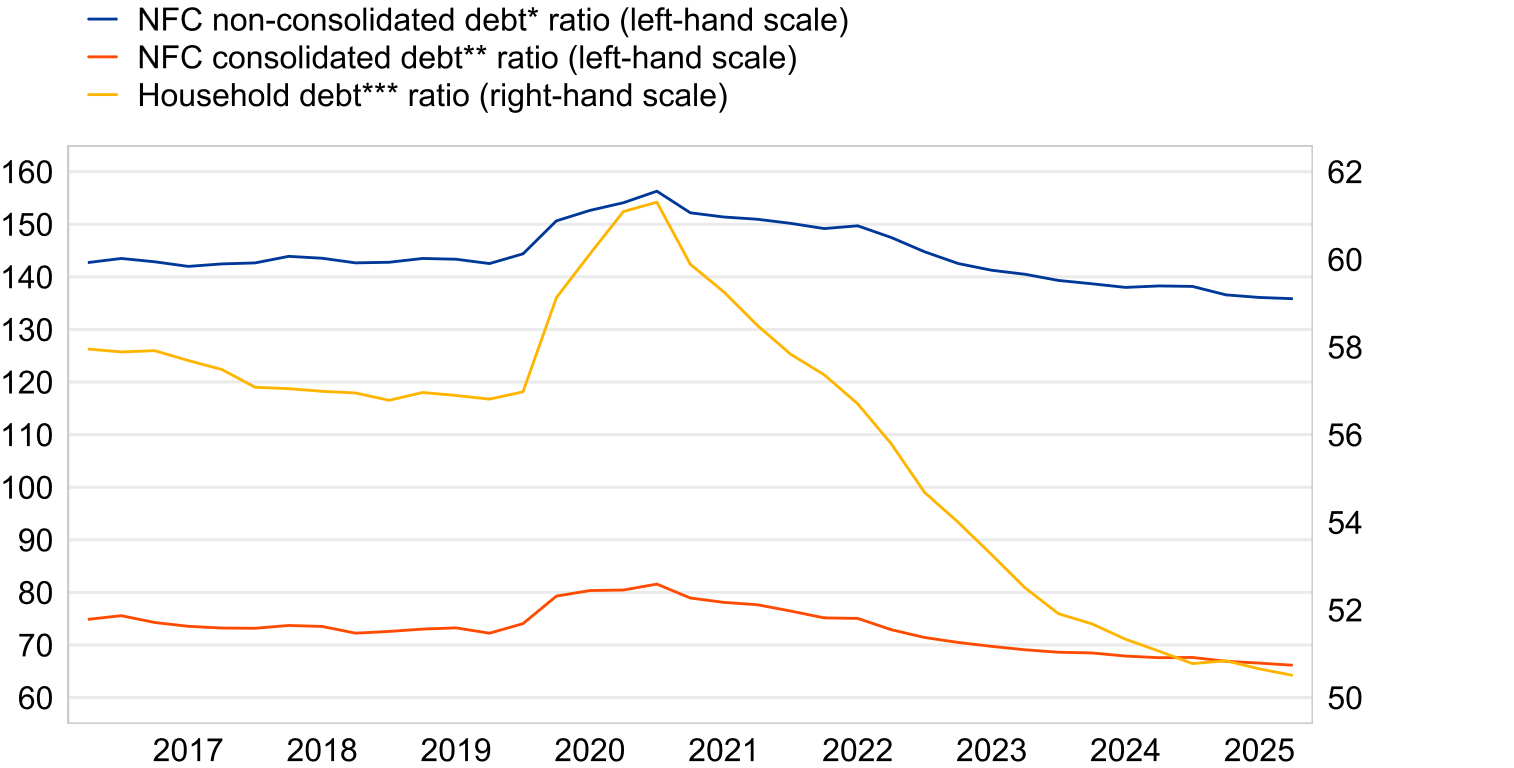
The household debt-to-income ratio[3] decreased to 81.4% in the fourth quarter of 2025 from 81.7% in the fourth quarter of 2024. The household debt-to-GDP ratio declined to 50.5% in the fourth quarter of 2025 from 51.1% in the fourth quarter of 2024 (see Chart 3).
Chart 3
Debt ratios of households and NFCs
(percentages of GDP)
Sources: ECB and Eurostat.
* Outstanding amount of loans, debt securities, trade credits and pension scheme liabilities.
** Outstanding amount of loans and debt securities, excluding debt positions between NFCs.
*** Outstanding amount of loan liabilities.
Non-financial corporations
Financing of NFCs increased at an unchanged annual rate of 1.5% in the fourth quarter of 2025, compared to the previous quarter (see Table 3 below). Financing via shares and other equity increased at an unchanged rate (0.7%). Financing via loans (2.6%, after 2.3%) increased at a higher rate, as loans granted by MFIs (3.0%, after 2.8%, see Table 3.2 in the Annex) and by other financial institutions (4.4%, after 3.7%), accelerated. Loans granted by other NFCs grew at a broadly unchanged rate (2.4%). Net issuance of debt securities grew at a higher rate (3.3%, after 2.5%), while financing via trade credits increased at a lower rate (3.9%, after 4.7%).
NFCs’ debt-to-GDP ratio (consolidated measure) decreased to 65.8% in the fourth quarter of 2025, from 67.3% in the fourth quarter of 2024; the non-consolidated, wider debt measure decreased to 135.8% from 138.3% (see Chart 2).
Table 3
Financing and financial investment of NFCs, main items
(annual growth rates)
Financial transactions |
|||||
|---|---|---|---|---|---|
2024 Q4 |
2025 Q1 |
2025 Q2 |
2025 Q3 |
2025 Q4 |
|
Financing* |
0.9 |
1.8 |
1.7 |
1.5 |
1.5 |
Debt securities |
1.8 |
1.7 |
1.9 |
2.5 |
3.3 |
Loans |
1.2 |
2.4 |
2.3 |
2.3 |
2.6 |
Shares and other equity |
0.7 |
1.2 |
0.9 |
0.7 |
0.7 |
Trade credits and advances |
2.7 |
4.6 |
4.5 |
4.7 |
3.9 |
Financial investment** |
1.8 |
2.9 |
2.5 |
2.2 |
2.1 |
Currency and deposits |
2.9 |
3.1 |
1.7 |
3.4 |
3.2 |
Debt securities |
4.3 |
5.8 |
4.2 |
5.7 |
6.6 |
Loans |
2.4 |
3.6 |
3.1 |
2.7 |
2.3 |
Shares and other equity |
0.8 |
1.3 |
1.3 |
0.9 |
0.8 |
Source: ECB.
* Items not shown include: pension schemes, other accounts payable, financial derivatives’ net liabilities and deposits.
** Items not shown include: other accounts receivable and prepayments of insurance premiums and reserves for outstanding claims.
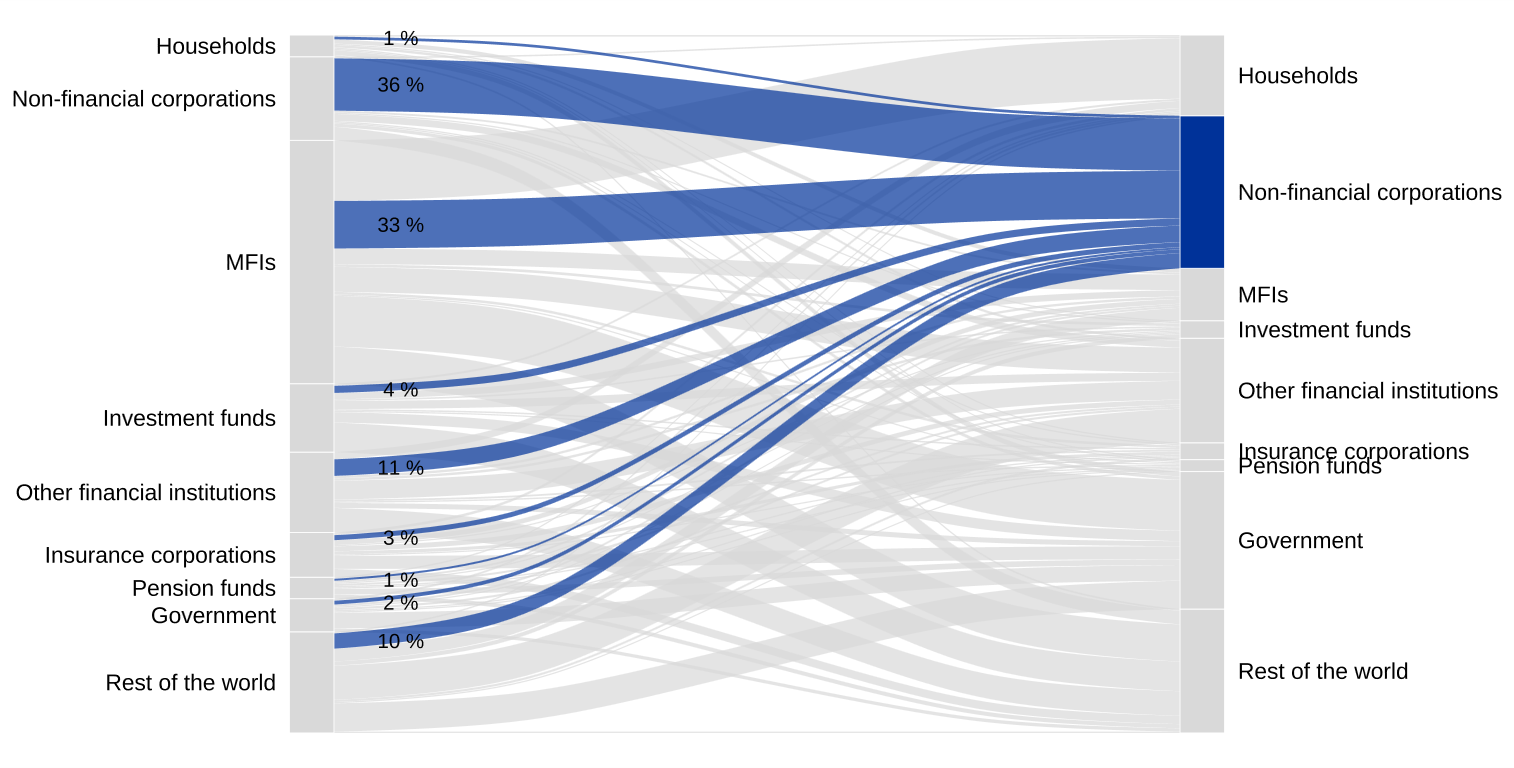
Chart 4 below shows main components of non-financial corporations’ debt (in dark blue) vis-à-vis counterpart sectors. At the end of 2025, the non-financial corporations’ debt in the form of loans and debt securities was held primarily by non-financial corporations (36%), MFIs (33%), other financial institutions (11%), and the rest of the world (10%).
Chart 4
The main components of NFC debt (loans and debt securities) by counterpart sector
(2025 end of period stocks)
Source: ECB.
Discrepancies between totals and their components may arise from rounding.
For queries, please use the statistical information request form.
Notes:
- These data come from a second release of quarterly euro area sector accounts for the fourth quarter of 2025 by the ECB and Eurostat, the statistical office of the European Union. This release incorporates revisions and completed data for all sectors compared with the first release on “Euro area households and non-financial corporations” of 9 April 2026.
- The euro area and national financial accounts data of NFCs and households are available in an interactive dashboard.
- The debt-to-GDP (or debt-to-income) ratios are calculated as the outstanding amount of debt in the reference quarter divided by the sum of GDP (or income) in the four quarters to the reference quarter. The ratio of non-financial transactions (e.g. savings) as a percentage of income or GDP is calculated as the sum of the four quarters to the reference quarter for both numerator and denominator.
- The annual growth rate of non-financial transactions and of outstanding assets and liabilities (stocks) is calculated as the percentage change between the value for a given quarter and that value recorded four quarters earlier. The annual growth rates used for financial transactions refer to the total value of transactions during the year in relation to the outstanding stock a year before.
- Hyperlinks in the main body of the statistical release lead to data that may change with subsequent releases as a result of revisions. Figures shown in annex tables are a snapshot of the data as at the time of the current release.
- The ECB publishes experimental Distributional Wealth Accounts (DWA) which provide additional breakdowns for the household sector. The release of results for 2025 Q4 will take place on 29 May 2026.
Legal Disclaimer:
EIN Presswire provides this news content "as is" without warranty of any kind. We do not accept any responsibility or liability for the accuracy, content, images, videos, licenses, completeness, legality, or reliability of the information contained in this article. If you have any complaints or copyright issues related to this article, kindly contact the author above.
