

X-Ray Detectors Market In 2029
X-Ray Detectors Market Report

X-Ray Detectors Market Report

X-Ray Detectors Market Report
The Business Research Company’s X-Ray Detectors Global Market Report 2026 – Market Size, Trends, And Forecast 2026-2035
LONDON, GREATER LONDON, UNITED KINGDOM, January 9, 2026 /EINPresswire.com/ -- X-Ray Detectors Market to Surpass $7 billion in 2029. In comparison, the Other Electrical & Electronics market, which is considered as its parent market, is expected to be approximately $218 billion by 2029, with X-Ray Detectors to represent around 3.2% of the parent market. Within the broader Electrical And Electronics industry, which is expected to be $5,240 billion by 2029, the X-Ray Detectors market is estimated to account for nearly 0.1% of the total market value.
Which Will Be the Biggest Region in the X-Ray Detectors Market in 2029
North America will be the largest region in the x-ray detectors market in 2029, valued at $2,155 million. The market is expected to grow from $1,575 million in 2024 at a compound annual growth rate (CAGR) of 6%. The strong growth can be attributed to the government support and investments in healthcare modernization and rising prevalence of chronic diseases and cancer.
Which Will Be The Largest Country In The Global X-Ray Detectors Market In 2029?
The USA will be the largest country in the x-ray detectors market in 2029, valued at $1,885 million. The market is expected to grow from $1,371 million in 2024 at a compound annual growth rate (CAGR) of 7%. The strong growth can be attributed to the growing demand from industrial and security applications and rising prevalence of chronic diseases and cancer.
Request a free sample of the X-Ray Detectors Market report:
https://www.thebusinessresearchcompany.com/sample_request?id=8385&type=smp
What will be Largest Segment in the X-Ray Detectors Market in 2029?
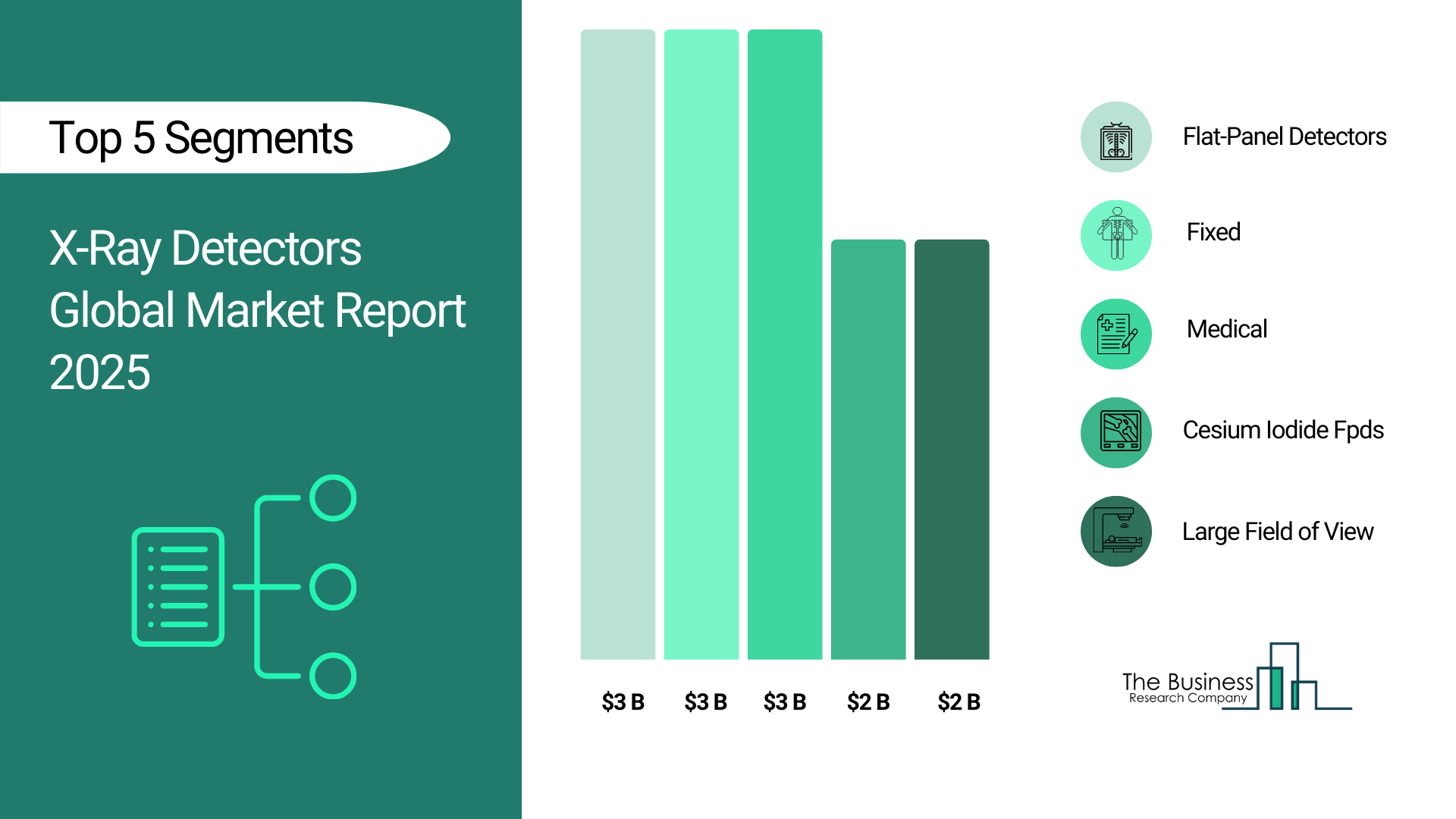
The x-ray detectors market is segmented by technology into flat-panel detectors, computed radiography detectors, line-scan detectors and charge-coupled device detectors. The flat-panel detectors market will be the largest segment of the x-ray detectors market segmented by technology, accounting for 56% or $3,935 million of the total in 2029. The flat-panel detectors market will be supported by rapid digitalization in medical imaging, replacement of analog systems with compact digital alternatives, rising investments in radiology departments, advantages such as faster image processing and storage, broad application in medical, dental, and security imaging, increasing demand for wireless and portable systems, and continuous research and development improving detector efficiency and reliability. This aligns with the industry-wide shift from computed radiography (CR) to digital radiography (DR).
The x-ray detectors market is segmented by portability into portable and fixed. The fixed market will be the largest segment of the x-ray detectors market segmented by portability, accounting for 58% or $4,042 million of the total in 2029. The fixed market will be supported by strong adoption in hospitals and large imaging centers, superior image quality for advanced diagnostic procedures, integration in radiography rooms with high patient volumes, cost efficiency in long-term use, rising demand for fixed detectors in oncology and cardiology imaging, advancements in software integration for workflow optimization, and preference in large-scale industrial and security applications.
The x-ray detectors market is segmented by field of view into large field of view FPDs, medium field of view FPDs and small field of view FPDs. The large field of view FPDs market will be the largest segment of the x-ray detectors market segmented by field of view, accounting for 48% or $3,364 million of the total in 2029. The large field of view FPDs market will be supported by increasing use in chest and full-body imaging, demand in interventional radiology and angiography procedures, suitability for high-throughput imaging departments, enhanced ability to capture large anatomical regions in a single scan, preference in airport and cargo security screening, integration in advanced fluoroscopy systems, and rising adoption in industrial quality inspection of large components. The technology is essential for major medical imaging applications like general radiography, fluoroscopy, and mammography.
The x-ray detectors market is segmented by application into medical, security, veterinary, industrial and other applications. The medical market will be the largest segment of the x-ray detectors market segmented by application, accounting for 56% or $3,941 million of the total in 2029. The medical market will be supported by rising prevalence of chronic diseases requiring diagnostic imaging, increasing global healthcare spending, growing adoption of minimally invasive procedures, continuous upgrades in hospital radiology departments, demand for faster and more accurate diagnosis, rising patient preference for lower radiation imaging, and government initiatives to modernize healthcare infrastructure.
What is the expected CAGR for the X-Ray Detectors Market leading up to 2029?
The expected CAGR for the x-ray detectors market leading up to 2029 is 7%.
What Will Be The Growth Driving Factors In The Global X-Ray Detectors Market In The Forecast Period?
The rapid growth of the global x-ray detectors market leading up to 2029 will be driven by the following key factors that are expected to reshape medical diagnostics, industrial quality control, and security screening processes worldwide.
Rising Geriatric Population – The rising geriatric population will become a key driver of growth in the x-ray detectors market by 2029. An increasing share of the global population is aging, which leads to greater demand for diagnostic imaging because older individuals typically experience more health conditions requiring monitoring, screening, and follow-up. As people age, the incidence of bone disorders, degenerative joint diseases, osteoarthritis, osteoporosis, cardiovascular issues, and other age-related pathologies rises, all of which often require routine X-ray imaging to diagnose or monitor. This increase in imaging volume exerts pressure on hospitals and diagnostic centers to upgrade or expand their digital radiography capacities, particularly by investing in more sensitive, faster, and higher resolution X-ray detectors to handle larger throughput while maintaining image quality and reducing radiation dose. The trend also pushes innovation toward more user-friendly, portable, or bedside detectors so that elderly or mobility-impaired patients can be imaged more easily, increasing adoption of detector systems optimized for these use cases. The cumulative effect is that as geriatric population grows, more X-ray detectors are needed across healthcare infrastructure to meet the clinical demand. As a result, the rising geriatric population is anticipated to contributing to a 1.0% annual growth in the market.
Rising Prevalence Of Chronic Diseases And Cancer - The rising prevalence of chronic diseases and cancer will emerge as a major factor driving the expansion of the market by 2029. Chronic diseases (such as cardiovascular disease, diabetes, chronic respiratory conditions) and cancer are becoming more prevalent globally, and many of these conditions demand repeated imaging procedures for diagnosis, staging, monitoring response to therapy, or detecting complications. For example, cancer patients may need periodic X-ray based imaging (chest X-rays, bone scans) as part of treatment follow-up or to detect metastases. Similarly, chronic pulmonary or cardiac patients often require imaging to monitor disease progression or treatment impact. This continuous demand for diagnostic and monitoring imaging makes robust, reliable detectors essential in clinical workflows. To keep up with the increasing volume and complexity of imaging use, healthcare providers will push for detectors with higher efficiency, better sensitivity, lower noise, and improved processing (e.g., AI image enhancements), thereby expanding demand for advanced X-ray detectors. The rising chronic disease burden also motivates modular or scalable detector upgrades and calibration or maintenance services to extend lifespan and performance of installed systems. Consequently, the rising prevalence of chronic diseases and cancer is projected to contributing to a 0.7% annual growth in the market.
Government Support And Investments In Healthcare Modernization - The government support and investments in healthcare modernization will serve as a key growth catalyst for the market by 2029. Governments in many countries are investing in healthcare infrastructure upgrades, digital transformation initiatives, and diagnostic facility expansions, often as part of public health programs or stimulus measures. These investments include upgrading from analog to digital imaging, procuring modern detector systems, and funding hospital modernization projects. Supported by national health policy, grants, subsidies, or health infrastructure budgets, such investments lower barriers for adoption of advanced X-ray detector technologies. Because public healthcare institutions often serve large patient volumes, these procurements translate into sizable orders for detectors and related services (installation, calibration, maintenance). In parallel, governments may mandate stricter imaging regulation, safety standards, or imaging capacity minimums (e.g., for screening programs), which encourages institutions to replace outdated detectors with compliant next-generation systems. Thus, government support acts as a catalyst, channeling capital and priority into markets for X-ray detector hardware, software upgrades, and service ecosystems. Therefore, this government support and investments in healthcare modernization is projected to supporting to a 0.5% annual growth in the market.
Growing Demand From Industrial And Security Applications - The growing demand from industrial and security applications will become a significant driver contributing to the growth of the market by 2029. Beyond medical use, industrial inspection (non-destructive testing, materials inspection, electronics, defect detection) and security screening (airports, cargo, border control) increasingly rely on X-ray imaging and detectors. Industrial sectors require detectors that are rugged, fast, and capable of capturing fine structural or defect details in materials. As manufacturing, energy, and infrastructure projects expand globally, inspection and quality assurance demand rise, pushing adoption of advanced digital X-ray detectors in factories and NDT (non-destructive testing) labs. In security and transportation, growing volumes of passenger traffic, cargo shipment, and heightened concerns over contraband, threat detection, and border security motivate investments in high-resolution, throughput-capable detectors. Government mandates tighter security, customs inspection regimes, and modernization of airports also feed demand. As these non-medical sectors scale demand, they widen the addressable market for X-ray detector manufacturers and service providers. Consequently, the growing demand from industrial and security applications is projected to contributing to a 0.2% annual growth in the market.
Access the detailed X-Ray Detectors Market report here:
https://www.thebusinessresearchcompany.com/report/x-ray-detectors-global-market-report
What Are The Key Growth Opportunities In The X-Ray Detectors Market in 2029?
The most significant growth opportunities are anticipated in the medical X-ray detection systems market, the flat-panel X-ray detectors market, the large-area X-ray detector systems market, and the fixed X-ray imaging detectors market. Collectively, these segments are projected to contribute over $5 billion in market value by 2029, driven by advancements in detector technology, increasing demand for high-resolution and large-area imaging, and rising adoption of fixed imaging solutions across medical and industrial applications. This growth is further fuelled by the need for enhanced diagnostic accuracy, improved patient safety, and expanding utilization of digital radiography systems, positioning these markets at the forefront of innovation within the broader x-ray detection industry.
The medical X-ray detection systems market is projected to grow by $1,293 million, the flat-panel X-ray detectors market by $1,228 million, the large-area X-ray detector systems market by $1,083 million, and the fixed x-ray imaging detectors market by $1,056 million over the next five years from 2024 to 2029.
The Business Research Company (www.thebusinessresearchcompany.com) is a leading market intelligence firm renowned for its expertise in company, market, and consumer research. We have published over 17,500 reports across 27 industries and 60+ geographies. Our research is powered by 1,500,000 datasets, extensive secondary research, and exclusive insights from interviews with industry leaders.
We provide continuous and custom research services, offering a range of specialized packages tailored to your needs, including Market Entry Research Package, Competitor Tracking Package, Supplier & Distributor Package and much more
Disclaimer: Please note that the findings, conclusions and recommendations that TBRC Business Research Pvt Ltd delivers are based on information gathered in good faith from both primary and secondary sources, whose accuracy we are not always in a position to guarantee. As such TBRC Business Research Pvt Ltd can accept no liability whatever for actions taken based on any information that may subsequently prove to be incorrect. Analysis and findings included in TBRC reports and presentations are our estimates, opinions and are not intended as statements of fact or investment guidance.
The Business Research Company
Americas +1 310-496-7795
Europe +44 7882 955267
Asia & Others +44 7882 955267 & +91 8897263534
Email: info@tbrc.info
Oliver Guirdham
The Business Research Company
+44 7882 955267
info@tbrc.info
Visit us on social media:
LinkedIn
Facebook
X
Legal Disclaimer:
EIN Presswire provides this news content "as is" without warranty of any kind. We do not accept any responsibility or liability for the accuracy, content, images, videos, licenses, completeness, legality, or reliability of the information contained in this article. If you have any complaints or copyright issues related to this article, kindly contact the author above.
